

ASX Defies Wall Street Gloom as Gold Rally Ignites Miners Ahead of CPI Test

Key Highlights
- ASX 200 surges over 2% despite US market weakness
- Gold hits US$4,578, driving an 8% spike in gold stocks
- Materials sector leads with a 4.42% gain
- Energy stocks fall sharply as oil drops over 6%
- CPI data emerges as the key trigger for next market move
Australian share market is moving to its own rhythm.
While Wall Street struggled overnight under the pressure of rising bond yields and geopolitical uncertainty, the ASX opened with conviction. By midday, the S&P/ASX 200 climbed 2.13% to 8,558 points, supported by a powerful rally in gold and mining stocks.
Source: MarketIndex
It is a clear divergence. And it is not happening by accident.
At the heart of today’s move is a structural difference between markets.
The US is dominated by growth and technology stocks, which are sensitive to interest rates. Australia, by contrast, is a resource-heavy market. When commodities rise, the ASX tends to benefit.
That dynamic is now fully on display.
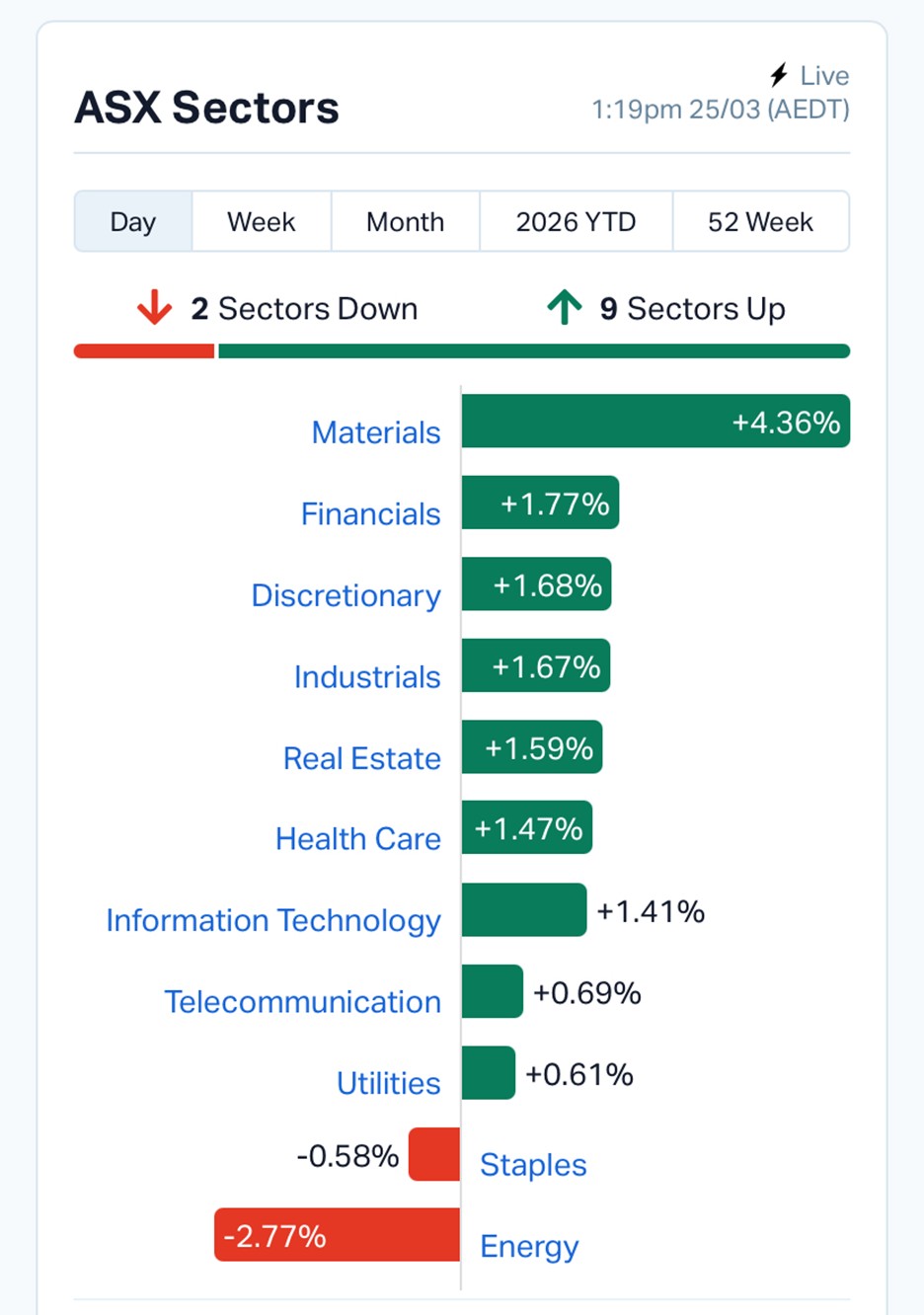
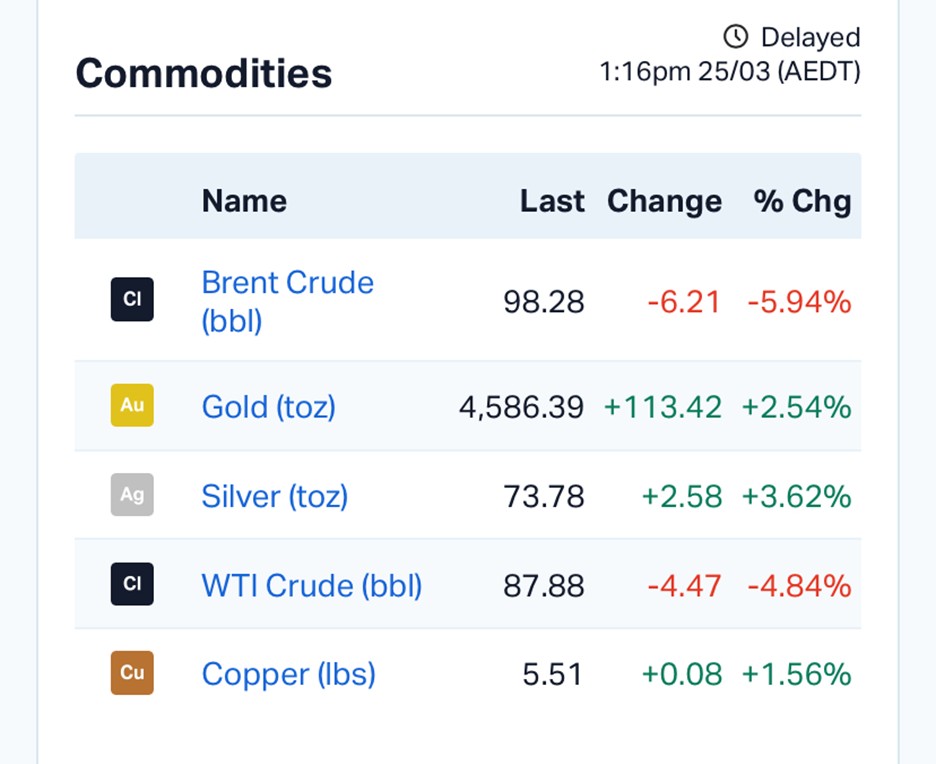
Gold surged 2.35% to US$4,578 per ounce, triggering a sharp re-rating across mining stocks. The ASX All Ordinaries Gold Index jumped 8.25%, while the broader materials sector rose 4.42%.
Source: MarketIndex
According to analysts cited by the International Energy Agency, commodity demand is entering a long-term expansion phase, driven by electrification, energy transition, and AI infrastructure. This is not just a short-term spike. It is a structural trend.
Expert View: Echoes of the 1970s
The current setup is beginning to look familiar to seasoned macro watchers.
Ben Picton, Senior Macro Strategist at Rabobank, has warned that markets may be underestimating the broader implications of supply shocks and inflation.
“We’re seeing interest rates going up, whereas during COVID, we were cutting them. If the supply-side shock turns into a drop-off in demand, we might start seriously throwing around the word recession.”
That comparison to the 1970s is not casual. Back then, rising oil prices and inflation created a prolonged period of economic stress, but also drove commodities like gold to historic highs.
Today’s environment is not identical, but the ingredients are similar.
CPI: The market’s ticking clock
Despite the strong rally, there is a clear sense of caution in the market.
All attention is now on the CPI data due at 11:30am AEDT, with expectations that inflation will hold at 3.8%.
This number matters more than usual.
A higher reading could force the Reserve Bank of Australia into a more aggressive stance, potentially slowing the current rally. A softer print, however, could reinforce the view that inflation is stabilising, giving equities room to move higher.
As one market observer put it, markets right now are trading “headline to headline.”
Carol Schleif of BMO Private Wealth captured this sentiment succinctly:
“Stocks are trying to find their footing as investors are keeping one eye on social media and the other eye on every headline. We’re very short-term oriented.”
Sector breakdown: where money is flowing
Today’s session is defined by clear sector rotation.
The leaders: gold and resources
Gold miners are the standout winners, benefiting directly from rising bullion prices.
Stocks like Beacon Minerals (+12.92%) and other mid-cap resource players are seeing strong inflows. The ASX 200 Resources index is up over 3%, reinforcing the theme that commodities are back in focus.
There is also renewed strength in technology, with the ASX All Technology Index rising 2.13%, suggesting risk appetite is returning beyond defensive trades.
The laggards: energy and cyclicals
Energy stocks are under pressure, despite recent geopolitical tensions.
Oil prices have dropped sharply, with Brent crude falling over 6% to US$98.15. This has dragged down major names like Woodside Energy (-4.52%) and Karoon Energy (-8.25%).
Amplitude Energy led the declines, plunging 36.52% after disappointing drilling results.
This highlights the volatility in energy markets, where sentiment can shift rapidly between supply fears and demand concerns.
Stay ahead of the market
The most important stories, delivered to your inbox. No noise, just what matters.
By subscribing, you agree to our Privacy Policy.
Beyond the market: cost-of-living pressure builds
While markets rally, the real economy is telling a more complex story.
Rising commodity prices, particularly energy and food inputs, are beginning to feed into everyday costs.
Recent analysis highlighted by business reporters shows that consumer prices, even for basic items like Easter chocolates, have surged significantly over the past two years.
This disconnect between market performance and household experience is becoming more pronounced.
Global backdrop: cautious optimism
Globally, markets remain fragile.
The S&P 500 fell 0.37% and the Nasdaq dropped 0.84%, reflecting ongoing concerns around interest rates and geopolitical risks.
At the same time, Asian markets showed resilience, with the Hang Seng rising 2.79% and the Nikkei gaining 1.43%, suggesting that regional sentiment is stabilising.
The ASX is effectively sitting between these two worlds, benefiting from commodity strength while still exposed to global uncertainty.
Investors are rotating into sectors that offer both protection and upside in an uncertain environment. Gold provides a hedge. Mining stocks offer leverage to rising prices. And the ASX, by its very structure, is well placed to benefit.
But the next move will depend on one key variable.
Inflation.
If CPI surprises to the upside, today’s gains could be tested. If it comes in softer, the rally may have further room to run.
For now, the ASX is holding firm, even as global markets hesitate.
What is your take on this story?
Disclaimer - Skrill Network is designed solely for educational and informational use. The content on this website should not be considered as investment advice or a directive. Before making any investment choices, it is crucial to carry out your own research, taking into account your individual investment objectives and personal situation. If you're considering investment decisions influenced by the information on this website, you should either seek independent financial counsel from a qualified expert or independently verify and research the information.