

ASX Market Wrap: Banks Warn of Double Rate Hike as Oil Shock Ripples Through the Economy

Key Highlights:
- Big Four bank economists now expect two RBA rate hikes in 2026 amid oil-driven inflation pressures
- ASX edges higher with the S&P/ASX 200 up 0.39% to 8,726.4 on Wednesday
- Gold miners and rare earth stocks surge as investors rotate into commodities
- Tech stocks retreat as rate expectations rise again
- Oil near US$88 per barrel continues to fuel inflation fears
Australia’s share market managed a modest rise on Wednesday, but beneath the surface a deeper shift is taking place. Economists at major banks are now warning that the era of expected rate cuts may be over.
Instead, the conversation has flipped to the possibility of two new interest rate hikes, driven largely by the inflationary shock from global energy markets.
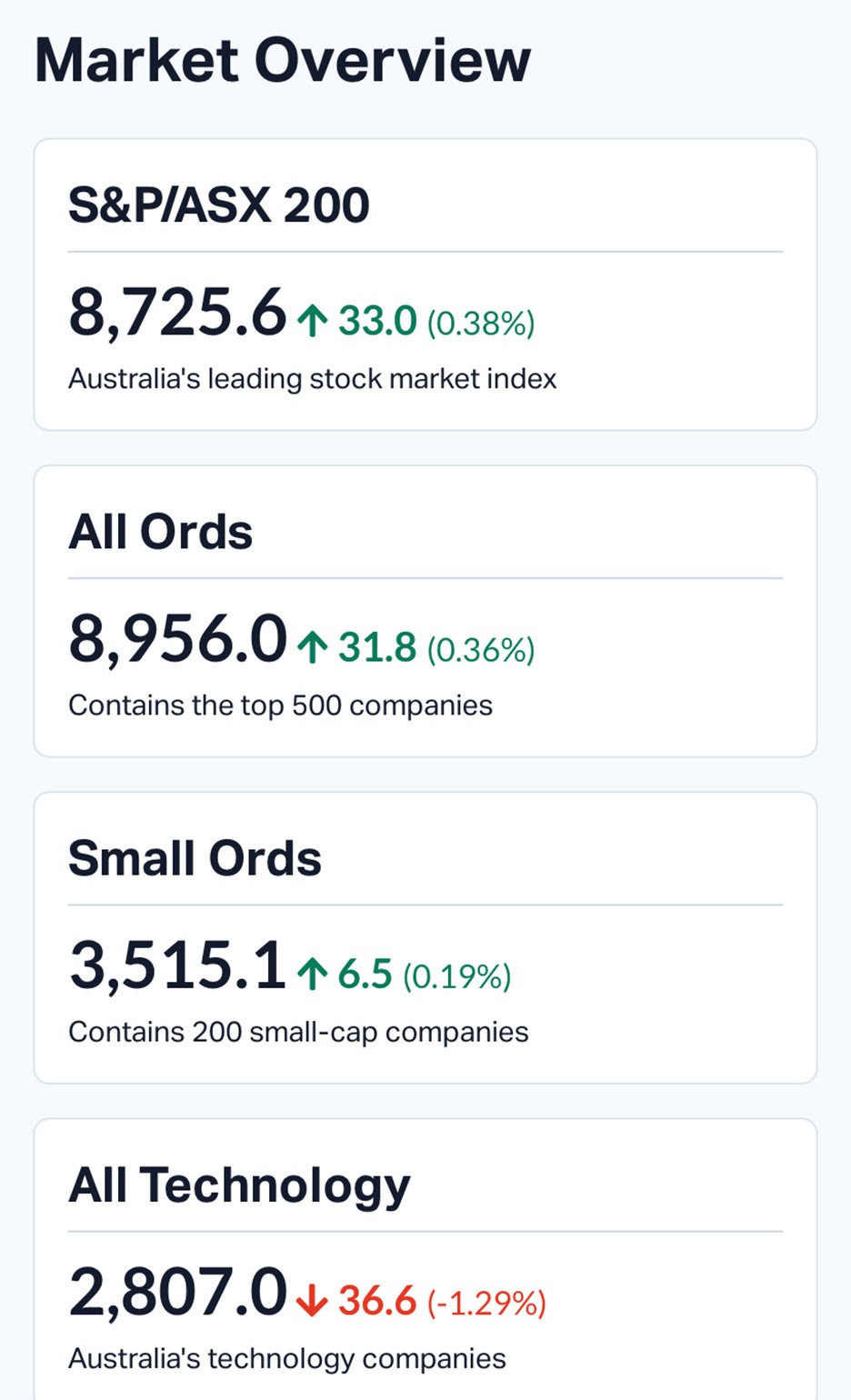
The S&P/ASX 200 is hovering around 8,726 points, up 0.39 percent, while the broader All Ordinaries index gained 0.37 percent.
The rebound came despite weakness across most sectors, with commodity stocks doing much of the heavy lifting.
At the same time, rising fuel costs are beginning to ripple through the economy, pushing up transport and grocery prices and forcing economists to reassess the outlook for the Reserve Bank of Australia.
Source: MarketIndex
Oil shock hits household budgets
The change in outlook follows the surge in global energy prices triggered by ongoing tensions around Middle East oil supply routes.
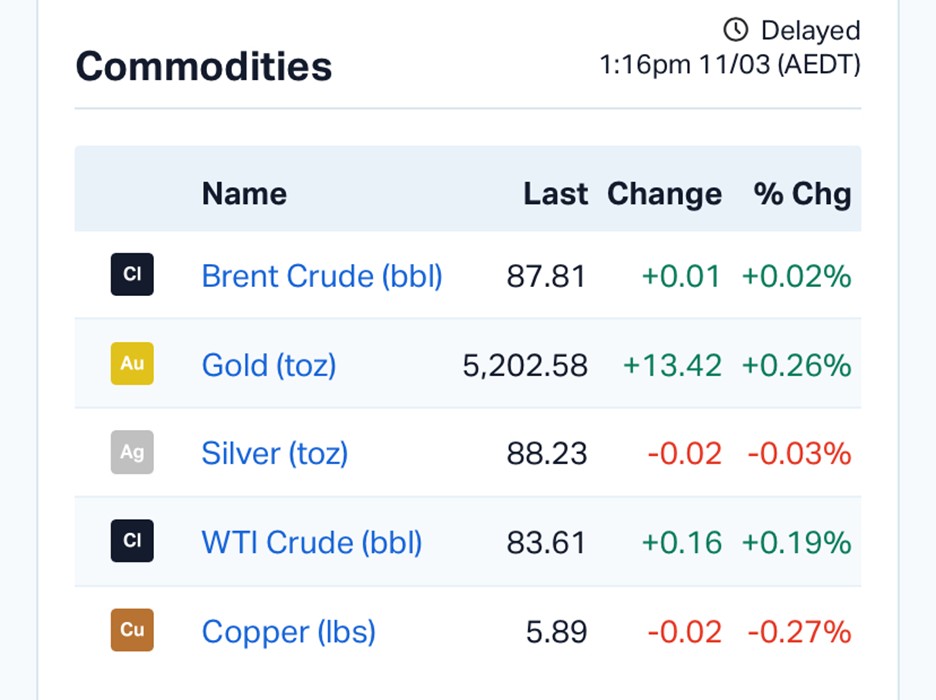
Even though Brent crude has eased slightly to about US$87.70 per barrel, analysts say the earlier spike has already begun feeding into inflation across supply chains.
Source: MarketIndex
Fuel costs are a critical component of Australia’s transport network. The Australian Trucking Association estimates that every 5 cent increase in diesel prices pushes transport invoices up about 1.55 percent.
That increase eventually flows through to supermarket shelves.
The oil shock does not stop at petrol pumps. It shows up in grocery bills.
Economists say that inflationary pressure is now strong enough to force the central bank’s hand.
Sally Auld, Chief Economist at NAB, said the underlying economic conditions were already pointing toward tighter policy before the energy shock hit.
“The starting point of robust growth, a too-tight labour market and too-high inflation already supported further tightening,” Auld said.
“New upside pressure on inflation tips the balance in favour of an additional increase.”
Both NAB and Westpac now expect the Reserve Bank to lift interest rates twice in coming months, potentially in March and May.
Market reaction: commodities surge
Despite the looming rate fears, parts of the ASX found strong support.
Mining stocks and commodity producers dominated the list of top performers as investors rotated toward assets that traditionally benefit during inflationary periods.
Among the standout movers was Ora Banda Mining, which surged 18.2 percent to $1.38, riding a powerful rally in gold prices.
Gold has climbed to roughly A$5,210 per ounce, reflecting a global rush toward traditional safe havens during periods of geopolitical uncertainty.
Another standout was Lynas Rare Earths, which jumped 12.1 percent to $19.87 after securing a long-term supply agreement with Japanese customers.
Rare earth elements are considered critical minerals used in electric vehicles, wind turbines and defence technology, making Lynas one of Australia’s most strategically important resource companies.
The ASX All Ordinaries Gold Index rose 0.94 percent, while the ASX 200 Resources index gained 1.29 percent.
Tech stocks feel the pressure
While commodity producers rallied, high-growth technology companies moved in the opposite direction.
The ASX All Technology Index fell 1.17 percent, reflecting renewed concerns that higher interest rates could weigh on valuations.
Companies such as Life360 were among the notable laggards, with shares dropping about 4.6 percent to $21.46.
Tech stocks are particularly sensitive to rate expectations because higher borrowing costs reduce the present value of future earnings.
This dynamic has been a recurring theme across global markets during the past two years.
Energy sector loses momentum
Energy stocks, which had surged during the earlier oil rally, also pulled back slightly.
Shares in Woodside Energy Group dipped around 0.5 percent, reflecting the modest cooling in oil prices.
Similarly, AGL Energy fell more than 5 percent, weighed down by regulatory pressures and concerns about rising input costs.
Stay ahead of the market
The most important stories, delivered to your inbox. No noise, just what matters.
By subscribing, you agree to our Privacy Policy.
The energy sector overall declined 0.49 percent.
Global markets offer mixed signals
Overnight leads from Wall Street provided little direction.
The S&P 500 slipped 0.21 percent, while the Dow Jones Industrial Average edged down 0.07 percent.
Meanwhile Asian markets were more upbeat. Japan’s Nikkei 225 jumped 2.88 percent, while Hong Kong’s Hang Seng rose 2.17 percent.
Economists say the global market is struggling to reconcile two competing forces: resilient economic growth on one side and inflation risks driven by energy markets on the other.
The bigger economic question
Beyond the daily market moves, the real concern lies in how energy prices reshape the broader economy.
Research firm Wood Mackenzie has warned that supply disruptions in the Middle East could remove as much as 15 million barrels of oil per day from global markets, potentially pushing crude toward US$150 per barrel in a worst-case scenario.
That scenario would dramatically increase inflation worldwide.
For Australia, it could mean the cost-of-living crisis entering a new phase.
Mortgage holders, already grappling with elevated borrowing costs, may soon face another challenge if the Reserve Bank is forced to tighten policy again.
Market snapshot
ASX indices (March 11, 2026):
Index | Level | Change |
S&P/ASX 200 | 8,726.4 | +0.39% |
All Ordinaries | 8,957.2 | +0.37% |
Small Ordinaries | 3,518.9 | +0.29% |
All Technology | 2,810.3 | -1.17% |
For now, the ASX appears relatively steady.
But with energy markets volatile and interest rate expectations shifting again, the calm may prove temporary.
The next move from the Reserve Bank could determine whether Australia’s economy slows gently or faces a tougher adjustment ahead.
What is your take on this story?
Disclaimer - Skrill Network is designed solely for educational and informational use. The content on this website should not be considered as investment advice or a directive. Before making any investment choices, it is crucial to carry out your own research, taking into account your individual investment objectives and personal situation. If you're considering investment decisions influenced by the information on this website, you should either seek independent financial counsel from a qualified expert or independently verify and research the information.