

ASX Market Wrap: Tech Rebounds as Oil Swings Keep Markets on Edge

Key Highlights
- ASX 200 rises 0.5% to 8,408 points after global relief rally
- Tech and resources lead gains while energy and banks lag
- Oil rebounds toward $US104, keeping inflation concerns alive
- Materials sector jumps 2.83% as gold stocks recover
- Volatility remains “normal” but geopolitical risks persist
A cautious rebound after chaos, but the tension hasn’t left the room
Australian share market found its footing today, but not without hesitation.
After a volatile start to the week driven by geopolitical shocks, the ASX 200 climbed 0.51% to 8,408 points, tracking a strong lead from Wall Street. The Dow Jones rose 1.38% overnight, while the Nasdaq posted a similar gain, helping restore confidence across global equities.
Yet beneath the surface, the mood remains fragile.
This is not a clean recovery. It is a market trying to stabilise while oil prices, inflation fears and geopolitical risks continue to pull in different directions.
The macro backdrop: relief rally meets lingering risk
The immediate catalyst for the rebound was a shift in tone from the United States, where President Donald Trump delayed potential strikes on Iranian infrastructure. That move eased fears of an imminent supply shock through the Strait of Hormuz, a route that handles roughly a quarter of global seaborne oil, according to the International Energy Agency.
Markets reacted quickly.
But the relief may be temporary.
Brent crude is already pushing back higher, rising 3.86% to $US103.80 per barrel, while WTI crude climbed to $US91.46. The speed of that rebound highlights a key reality. Supply concerns have not disappeared. They have simply been postponed.
Historically, oil shocks have played out over months rather than days. Research cited by the London School of Economics suggests disruptions in critical energy routes tend to ripple through inflation, shipping costs and economic growth long after the initial trigger.
Sector story: tech finds its footing, materials surge
Today’s session was defined by a rotation back into growth and cyclical sectors.
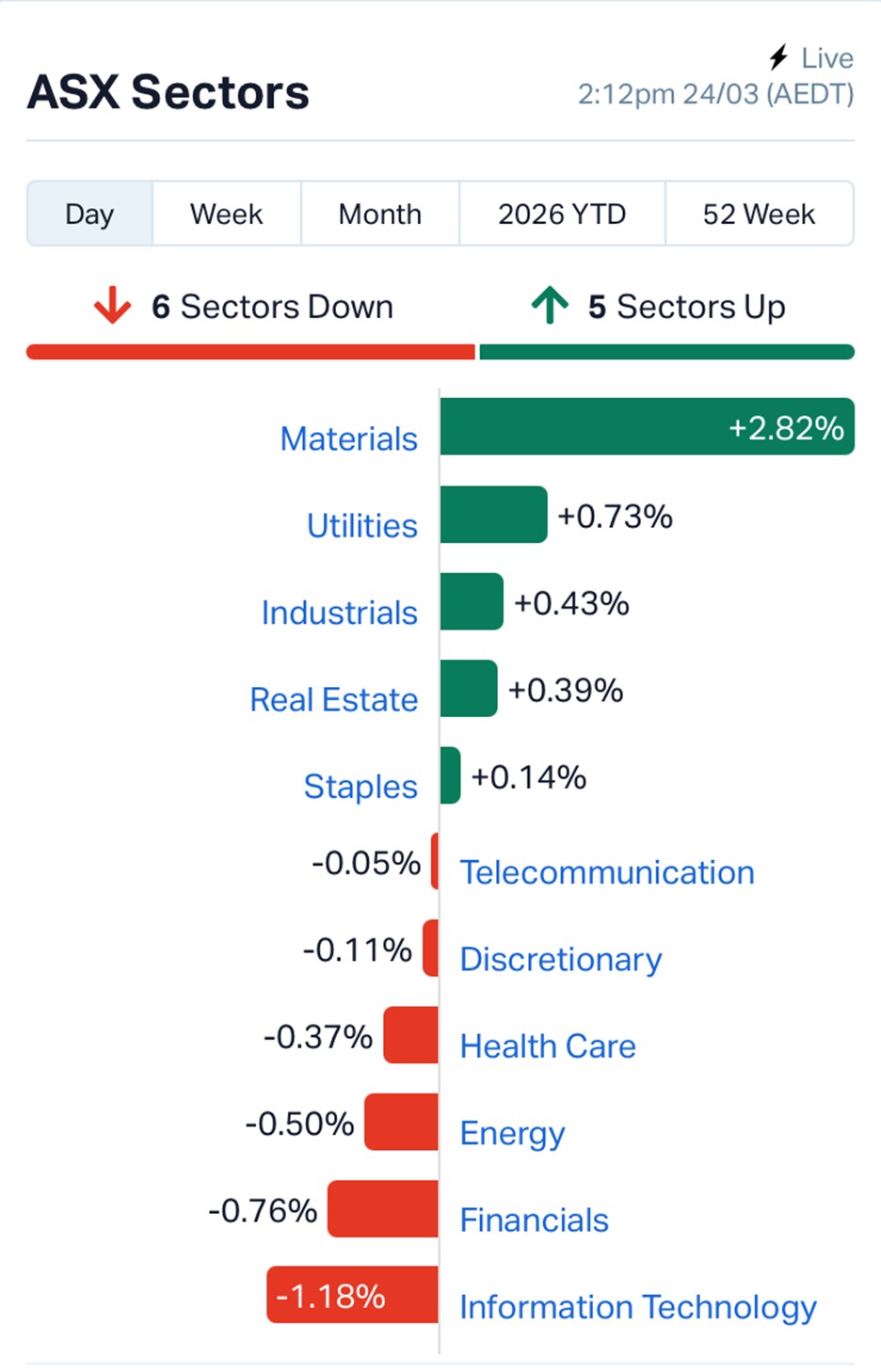
Materials led the charge, up 2.83%, with the ASX 200 Resources index gaining 2.29%. Gold stocks also staged a recovery, with the All Ordinaries Gold index rising 2.84% after recent heavy selling.
Source: MarketIndex
The rebound in resources reflects a familiar pattern. When uncertainty stabilises, even briefly, capital flows back into commodity-linked names.
Tech, however, told a more nuanced story.
While the broader narrative points to a “tech rebound,” the ASX All Technology Index slipped 0.65%, suggesting that gains were selective rather than broad-based. Investors appear to be favouring profitable, established tech names rather than speculative growth plays.
This divergence mirrors global trends. In the United States, the Nasdaq has rebounded strongly, but leadership remains concentrated in a handful of large-cap names rather than the broader tech ecosystem.
The laggards: energy and banks under pressure
Ironically, the very sector at the centre of the global narrative, energy, underperformed.
Energy stocks fell 0.45%, reflecting uncertainty rather than direction. When oil prices move sharply but unpredictably, it becomes harder for traders to position confidently.
Financials also struggled, down 0.98%, as rising interest rate expectations continue to weigh on sentiment. Higher rates typically support bank margins, but they also increase the risk of loan defaults and slow economic activity.
This tension is becoming more visible.
With inflation expectations climbing and central banks maintaining a hawkish stance, markets are beginning to price in a scenario where growth slows while costs remain elevated. A dynamic often compared to the stagflation period of the 1970s.
Stock movers: momentum meets reality
Among individual names, the session delivered a mix of speculative surges and sharp pullbacks.
Top gainers included:
- Echoiq (EIQ) +17.07%, driven by strong speculative interest
- BENZ Mining +15.59%, benefiting from renewed appetite in resource plays
- Metro Mining (MMI) +8.48%, continuing momentum in mid-cap miners
On the downside:
- BMC Minerals fell 14.53%
- Electro Optic Systems dropped 8.84%
- Droneshield declined 6.40% as profit-taking hit defence-linked stocks
The divergence highlights a broader theme. Liquidity is still present, but it is moving quickly between sectors rather than committing to a single direction.
Currency and commodities: signals from the sidelines
The Australian dollar weakened to 0.6969 US cents, down 0.59%, reflecting a stronger US dollar environment and ongoing global uncertainty.
Meanwhile, traditional safe havens struggled.
Gold fell 1.29% to $US4,351, while silver dropped 2.63%. This suggests that markets are not yet in full “risk-off” mode, despite the underlying tensions.
Copper, often seen as a proxy for global growth, slipped 0.94%, reinforcing concerns about slowing industrial demand.
Stay ahead of the market
The most important stories, delivered to your inbox. No noise, just what matters.
By subscribing, you agree to our Privacy Policy.
Volatility check: calm on the surface
The ASX Volatility Index sits at 18.0, placing it within the “normal” range.
On paper, that suggests stability.
In practice, it reflects a market that is waiting rather than relaxing. With geopolitical deadlines still looming and oil prices fluctuating, volatility could shift quickly.
What to watch next
The market is now entering a critical window.
The next few days will likely be shaped by three key factors:
- Geopolitical developments around the Strait of Hormuz and US-Iran relations
- Oil price direction, particularly whether Brent stabilises or pushes higher
- Interest rate expectations, as inflation pressures continue to build
There is also a broader structural shift underway.
Australia’s newly signed trade agreement with the European Union, removing 99% of tariffs, could reshape export dynamics over the coming years, providing a long-term buffer against regional economic shocks.
Today’s session offered a glimpse of what a stabilising market looks like, but it also exposed how fragile that stability remains.
Tech is attempting to rebound. Resources are benefiting from renewed confidence. Oil continues to dictate the broader narrative.
For now, the market is not choosing a direction. It is navigating uncertainty.
And in environments like this, where signals are mixed and risks are layered, the smartest moves often come not from chasing momentum, but from understanding where the next shock could emerge.
Source: ASX Market Data (March 24, 2026), International Energy Agency (IEA), London School of Economics Business Review
What is your take on this story?
Disclaimer - Skrill Network is designed solely for educational and informational use. The content on this website should not be considered as investment advice or a directive. Before making any investment choices, it is crucial to carry out your own research, taking into account your individual investment objectives and personal situation. If you're considering investment decisions influenced by the information on this website, you should either seek independent financial counsel from a qualified expert or independently verify and research the information.