

ASX Resilience Tested as ‘Hormuz Risk’ Sparks Energy Surge and Tech Retreat

Key Highlights:
- ASX 200 slips 0.48% to 9,154 as Middle East tensions rattle markets
- Energy sector jumps 4.15% as Brent crude rises above US$76
- Gold stocks rally 3.46% as investors seek safe havens
- Banks fall 2.22% amid global credit concerns
- Technology index drops 2.44% in broad risk off rotation
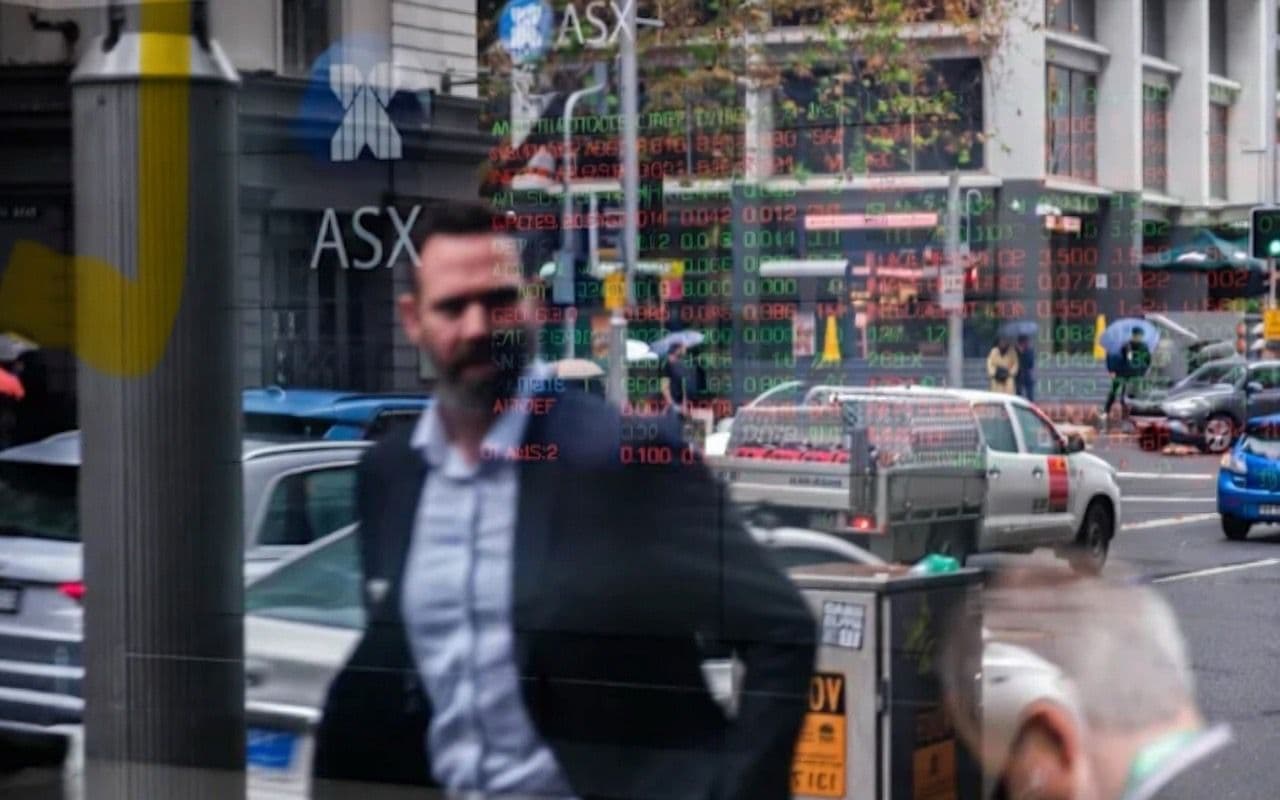
The Australian share market opened the week under pressure as geopolitical tensions in the Middle East sent investors scrambling toward energy and gold stocks, while banks and technology names bore the brunt of the sell off.
By early afternoon, the S&P/ASX 200 was down 0.48 percent to 9,154, reflecting what traders are calling “Hormuz risk” after renewed escalation between the United States, Israel, and Iran raised concerns over shipping routes in the Strait of Hormuz.
Roughly 20 to 25 percent of the world’s oil supply passes through the narrow waterway, according to global energy agencies. Any disruption there has immediate implications for fuel prices, inflation expectations, and global growth.
If oil flows through the Strait of Hormuz remain uninterrupted, the current rotation could stabilise. If disruption escalates, inflation expectations and global risk appetite could shift more sharply.
Source: MarketIndex | Live Data: 1:43 PM Sydney Time
Energy stocks act as shock absorbers
Oil prices responded swiftly. Brent crude rose 4.62 percent to US$76.24 per barrel, while US WTI climbed above US$69.
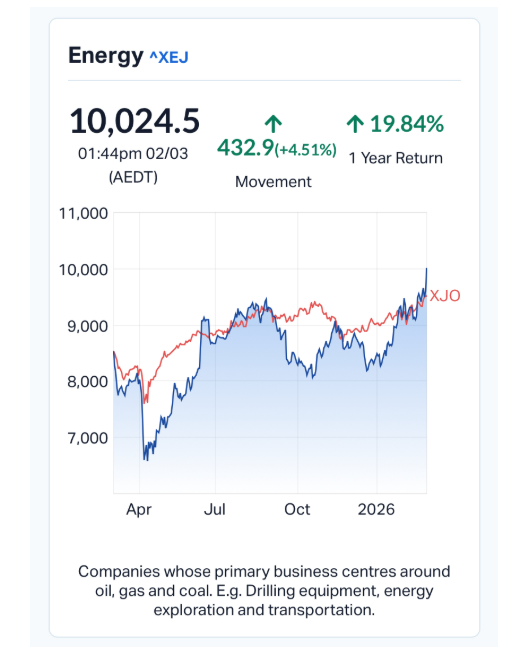
Source: MarketIndex | Live Data: 1:43 PM Sydney Time
The surge lifted Australian energy producers, with Karoon Energy Ltd jumping 11 percent and Woodside Energy Group Ltd among the session’s key beneficiaries.
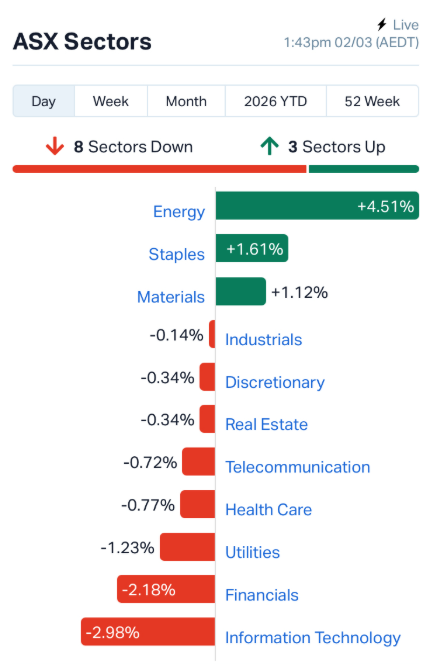
The broader Energy sector gained 4.15 percent, making it the strongest performer on the ASX.
Energy stocks often act as natural hedges during geopolitical flare ups. When oil prices rise, producers typically benefit from higher revenue per barrel, offsetting weakness in other sectors.
Dave Mazza of Roundhill Financial captured the conditional nature of the rally, saying:
“This is about Hormuz risk, not retaliation. If shipping stays open, stocks can work through it. If it doesn’t, all bets are off.”
One market strategist described the move as a “barbell” market, where defensive commodities are balancing weakness elsewhere.
Gold regains safe haven status
Investors also turned to precious metals. Spot gold climbed 0.94 percent to US$5,327 per ounce, pushing the ASX All Ordinaries Gold Index up 3.46 percent.
Newmont Corporation rose strongly as global investors sought safety from potential market volatility.
Gold has historically performed well during geopolitical crises and inflationary shocks. During previous Middle East tensions, similar price spikes were observed as investors sought assets perceived as stable stores of value.
Banks and technology retreat
While energy and gold rallied, risk sensitive sectors weakened sharply.
The ASX 200 Banks Index fell 2.22 percent, reflecting both global credit concerns and a broader pullback from financial stocks.
Recent turbulence in private credit markets in the United Kingdom and United States has unsettled investors. Analysts note that when global credit markets wobble, Australian banks often feel the ripple effect due to their exposure to international funding markets.
Technology stocks also declined, with the ASX All Technology Index sliding 2.44 percent.
High growth technology companies are particularly sensitive to rising oil prices and inflation concerns. Higher energy costs can feed into inflation expectations, potentially influencing central bank policy and borrowing costs.
Aviation sector caught in crosswinds
Rising fuel prices added pressure to airlines.
Qantas Airways Ltd fell amid concerns that higher jet fuel costs could erode margins. Airspace disruptions in the Middle East also raised operational uncertainty.
Airlines are particularly exposed during geopolitical shocks because fuel accounts for a substantial portion of operating expenses.
Defense tech draws speculative interest
Interestingly, not all risk assets declined.
DroneShield Ltd gained 10.77 percent, reflecting renewed interest in defense technology amid escalating global tensions.
The move underscores how certain sectors can benefit from heightened geopolitical risk, particularly companies tied to defense and security.
Currency and inflation implications
The Australian dollar traded around US 70.02 cents, slightly softer amid global uncertainty.
Economists note that while higher oil prices can increase headline inflation, sustained geopolitical uncertainty can dampen consumer sentiment and global demand.
Some analysts suggest that central banks, including the Reserve Bank of Australia, may be cautious about tightening monetary policy further amid heightened global instability.
A market under pressure, but not in panic
Despite the headline decline, volatility remains relatively contained. The ASX volatility index hovered near 13, indicating moderate investor caution rather than full scale panic.
Stay ahead of the market
The most important stories, delivered to your inbox. No noise, just what matters.
By subscribing, you agree to our Privacy Policy.
Market observers point out that the current reaction reflects sector rotation rather than broad capitulation.
Energy and gold stocks are absorbing much of the shock, cushioning the index from deeper losses.
The broader perspective
Geopolitical events have long shaped financial markets.
During previous crises involving Middle Eastern shipping routes, oil spikes have triggered temporary inflation fears but often led to short term sector realignments rather than prolonged downturns.
Today’s market reaction appears measured.
Energy producers are rising in tandem with oil prices. Safe haven assets are attracting capital. Growth sectors are retreating temporarily.
The bottom line
The Strait of Hormuz may be thousands of kilometres from Australia’s shores, but its impact on global oil supply reverberates instantly through financial markets.
For now, the ASX is demonstrating resilience through sector rotation.
Energy and gold are acting as shock absorbers. Banks and technology stocks are under pressure. Investors are adjusting portfolios rather than exiting the market altogether.
As geopolitical uncertainty unfolds, the key question remains whether oil flows continue uninterrupted.
If shipping lanes remain open, markets may stabilise quickly.
If not, the balance between inflation, growth, and risk could shift more dramatically in the weeks ahead.
Source: ASX market data, global commodity pricing, sector performance indices
What is your take on this story?
Disclaimer - Skrill Network is designed solely for educational and informational use. The content on this website should not be considered as investment advice or a directive. Before making any investment choices, it is crucial to carry out your own research, taking into account your individual investment objectives and personal situation. If you're considering investment decisions influenced by the information on this website, you should either seek independent financial counsel from a qualified expert or independently verify and research the information.