

ASX Sell-Off Deepens: $22 Billion Wiped from Travel Stocks as Oil Hits New Highs

Key Highlights:
- ASX 200 falls 1.29% to 9,082.1 by midday
- Brent crude climbs to $78.71 a barrel
- Global travel sector loses $22.6 billion in value
- RBA Governor warns March rate meeting is “live”
- Discretionary and real estate stocks lead declines
Australian shares slid sharply on Tuesday as a surge in oil prices and escalating Middle East tensions triggered a broad sell-off, wiping an estimated $22.6 billion from global travel stocks in just 24 hours.
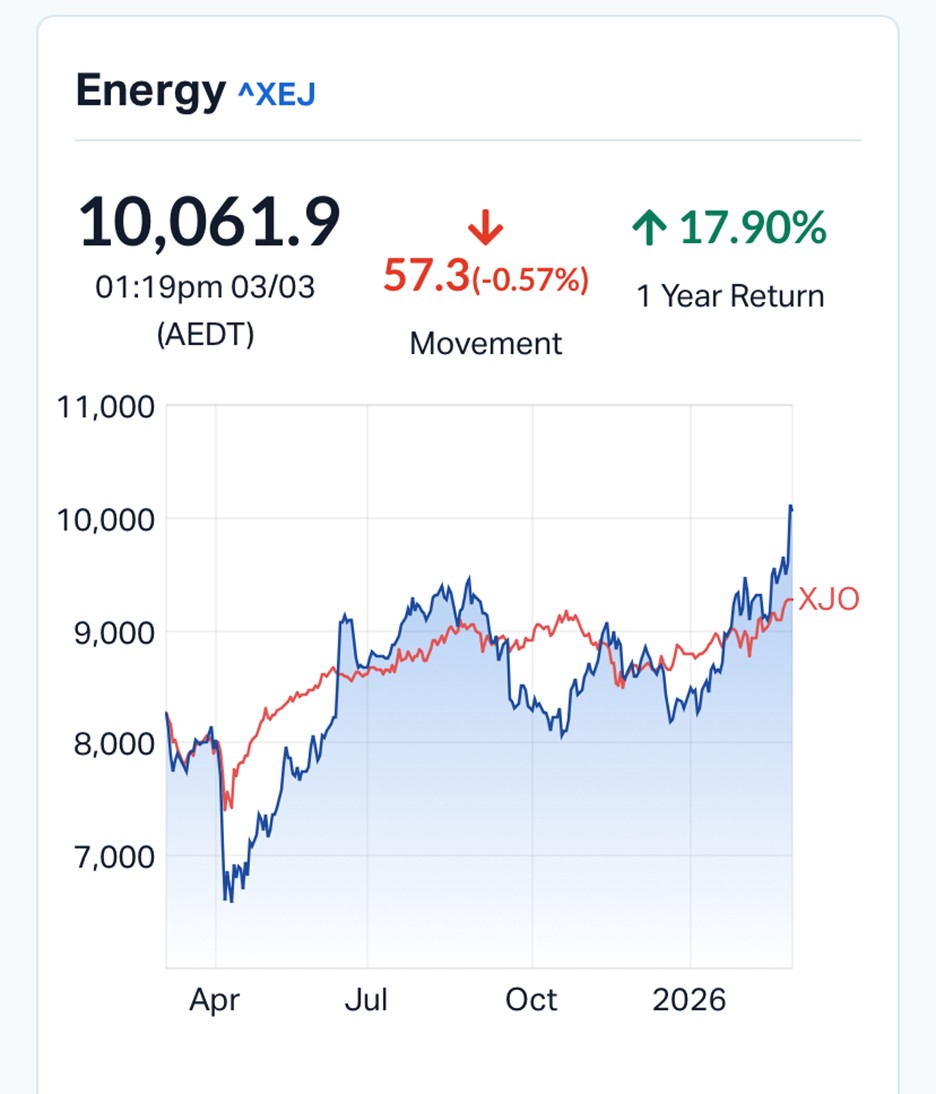
By 12:47pm AEDT, the S&P/ASX 200 was down 1.29% to 9,082.1, while the broader All Ordinaries index fell 1.34%. Eleven sectors were trading lower, with consumer discretionary stocks leading losses, down 2.81%.
At the centre of the market’s anxiety is oil.
Brent crude climbed to $78.71 a barrel, up 1.25% on the day, as concerns about disruption through the Strait of Hormuz intensified. That narrow shipping lane handles roughly a fifth of global oil supply, making it one of the most sensitive geopolitical chokepoints in the world.
When oil rises, airlines feel it first.
Source: MarketIndex
Travel stocks under pressure
The travel sector has been particularly hard hit. Globally, airlines and travel operators saw approximately $22.6 billion in market value erased as investors reacted to rising fuel costs and airspace closures across parts of the Middle East.
In Australia, shares in Qantas Airways Ltd were under renewed pressure as fuel cost concerns resurfaced. The airline had previously indicated it was “pretty well hedged” against short term oil volatility, but sustained price increases raise questions about margins heading into the second half of the year.
Rising jet fuel prices compound broader uncertainty around global travel demand if geopolitical tensions escalate further.
The pain extended beyond airlines. Retailers and consumer facing businesses also weakened as higher petrol prices threaten household budgets.
A double hit: Oil and interest rates
The oil spike comes at a delicate time for the Australian economy.
Reserve Bank Governor Michele Bullock has warned that the March 16 to 17 board meeting is “live” for a potential rate hike, adding: “The board will be actively looking at whether or not it needs to move more quickly. So I would discourage people from thinking that we necessarily only meet every quarter.”
That comment has sharpened market expectations that monetary policy could tighten sooner than previously thought.
At the same time, fresh economic data painted a softer domestic picture. Building approvals dropped 7.2% in January, driven by a 24.5% slump in apartment approvals. Australia also recorded a $21.1 billion current account deficit for the December quarter, a deterioration of $2.8 billion.
The combination of higher energy costs and the threat of rising interest rates has created what some analysts describe as a “double whammy” for equities.
Gold shines, but even miners retreat
Safe haven assets gained ground. Gold climbed to $5,373.64 an ounce, up nearly 1%, reflecting a classic flight to safety.
Yet even gold stocks struggled locally. The ASX All Ordinaries Gold Index fell 2.64% by midday, suggesting profit taking after recent gains.
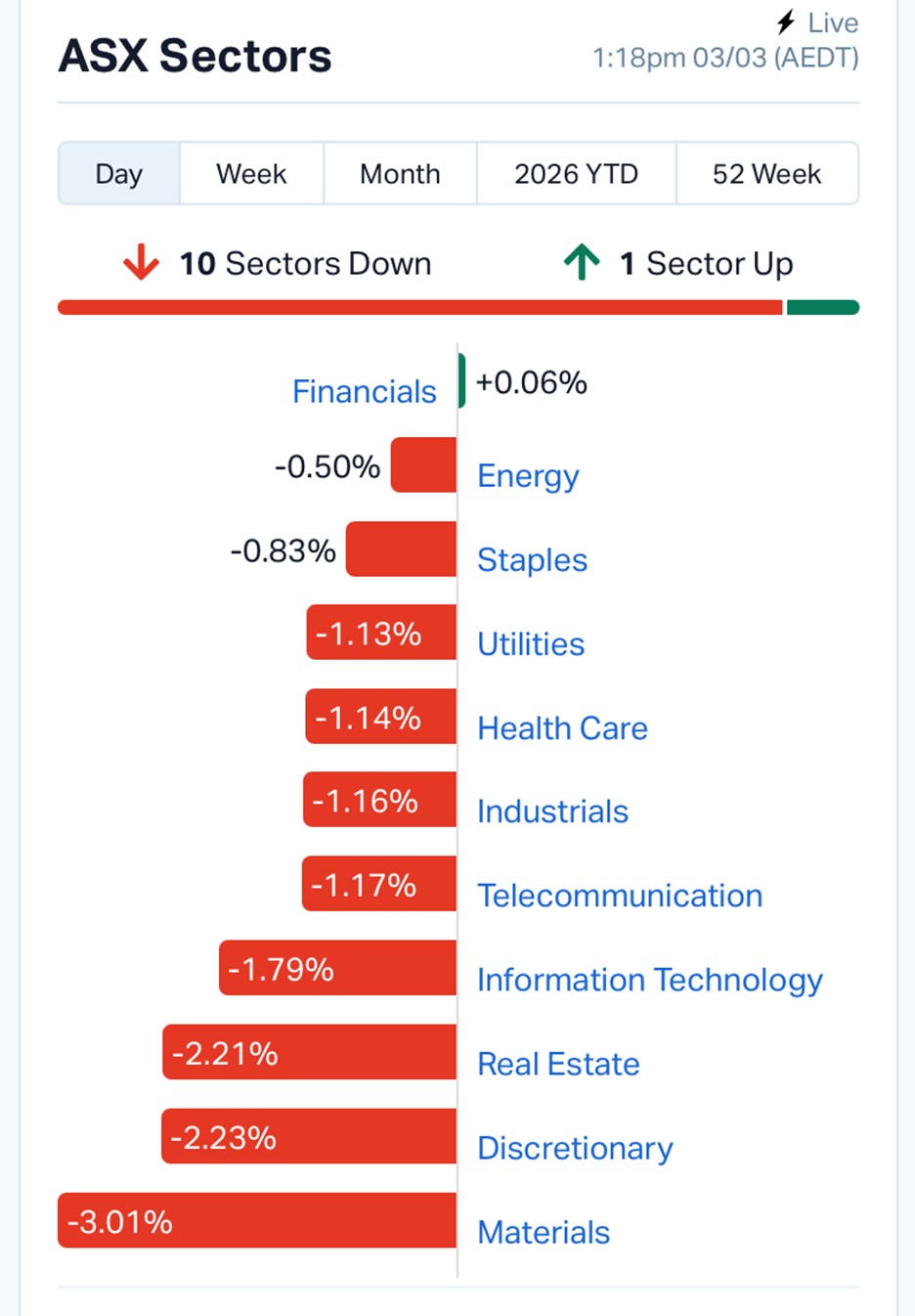
Energy stocks were comparatively resilient, slipping just 0.13% despite broader market weakness.
Sector Snapshot | MarketIndex
Pockets of strength
Amid the sea of red, a few stocks bucked the trend.
Magellan Financial Group Ltd surged 20.21% to $10.17 after announcing a successful $130 million capital raising to support its merger with Barrenjoey. The move was viewed as a decisive strategic step in an otherwise cautious environment.
Lindian Resources Ltd climbed 33.02% to $0.705 following a binding agreement to acquire a rare earths facility in Kazakhstan, underscoring ongoing investor appetite for critical minerals exposure.
But such gains were exceptions rather than the rule.
The ASX All Technology Index fell 1.79%, while materials dropped 1.95% and real estate declined 2.37%.
US markets add to the caution
Overnight in the United States, futures also moved lower as investors tracked the conflict.
Stay ahead of the market
The most important stories, delivered to your inbox. No noise, just what matters.
By subscribing, you agree to our Privacy Policy.
S&P 500 futures slipped 0.2%, Nasdaq 100 futures fell 0.3% and Dow futures were down around 85 points. This followed a volatile session in which the S&P 500 finished marginally higher and the Nasdaq gained 0.4% after rebounding from sharp intraday losses.
Defence stocks such as Northrop Grumman rose 6% and Palantir gained 5.8%, while Nvidia climbed about 3%, helping steady sentiment. Oil’s surge, however, has heightened inflation concerns globally.
Wall Street is now balancing geopolitical risk with upcoming earnings from CrowdStrike and Target later this week.
A broader context
Historically, oil shocks have had mixed impacts on equities. The 2008 spike above $140 a barrel coincided with global recession fears, while more recent supply disruptions have triggered short term volatility rather than sustained downturns.
This time, markets are balancing three forces at once: geopolitical tension, domestic rate uncertainty, and softening housing data.
The volatility index remains in the “low” range at 13.3, suggesting investors are cautious but not yet panicked.
The bottom line
Tuesday’s sell-off reflects more than a reaction to headlines. It signals a recalibration of risk.
Higher oil prices squeeze airlines and consumers. Hawkish central bank language raises borrowing costs. Slowing building approvals hint at underlying economic fragility.
For now, the ASX is navigating a landscape shaped as much by geopolitics as by earnings.
And as oil approaches fresh highs, the next move may depend less on corporate guidance and more on events unfolding thousands of kilometres away.
Source: ASX live market data, RBA comments, commodity price data as of 3 March 2026.
What is your take on this story?
Disclaimer - Skrill Network is designed solely for educational and informational use. The content on this website should not be considered as investment advice or a directive. Before making any investment choices, it is crucial to carry out your own research, taking into account your individual investment objectives and personal situation. If you're considering investment decisions influenced by the information on this website, you should either seek independent financial counsel from a qualified expert or independently verify and research the information.