

ASX Shudders as Middle East Conflict Collides With Looming RBA Rate Hike


Key Highlights
- ASX 200 slips 0.42% to 8,581.2 as geopolitical tensions rattle markets
- Oil climbs above US$104 per barrel, boosting energy stocks
- Investors brace for a likely RBA interest rate hike this week
- Tech and materials sectors lead declines while energy names rise
- Analysts warn high oil prices could slow global growth and fuel inflation
The Australian share market is navigating a delicate balancing act on Monday as rising geopolitical tensions and the prospect of higher interest rates weigh on investor sentiment.
At midday, the S&P/ASX 200 was down 0.42 percent to 8,581.2, while the All Ordinaries index fell 0.51 percent to 8,793.7. Beneath those headline numbers, however, the market tells a more complex story.
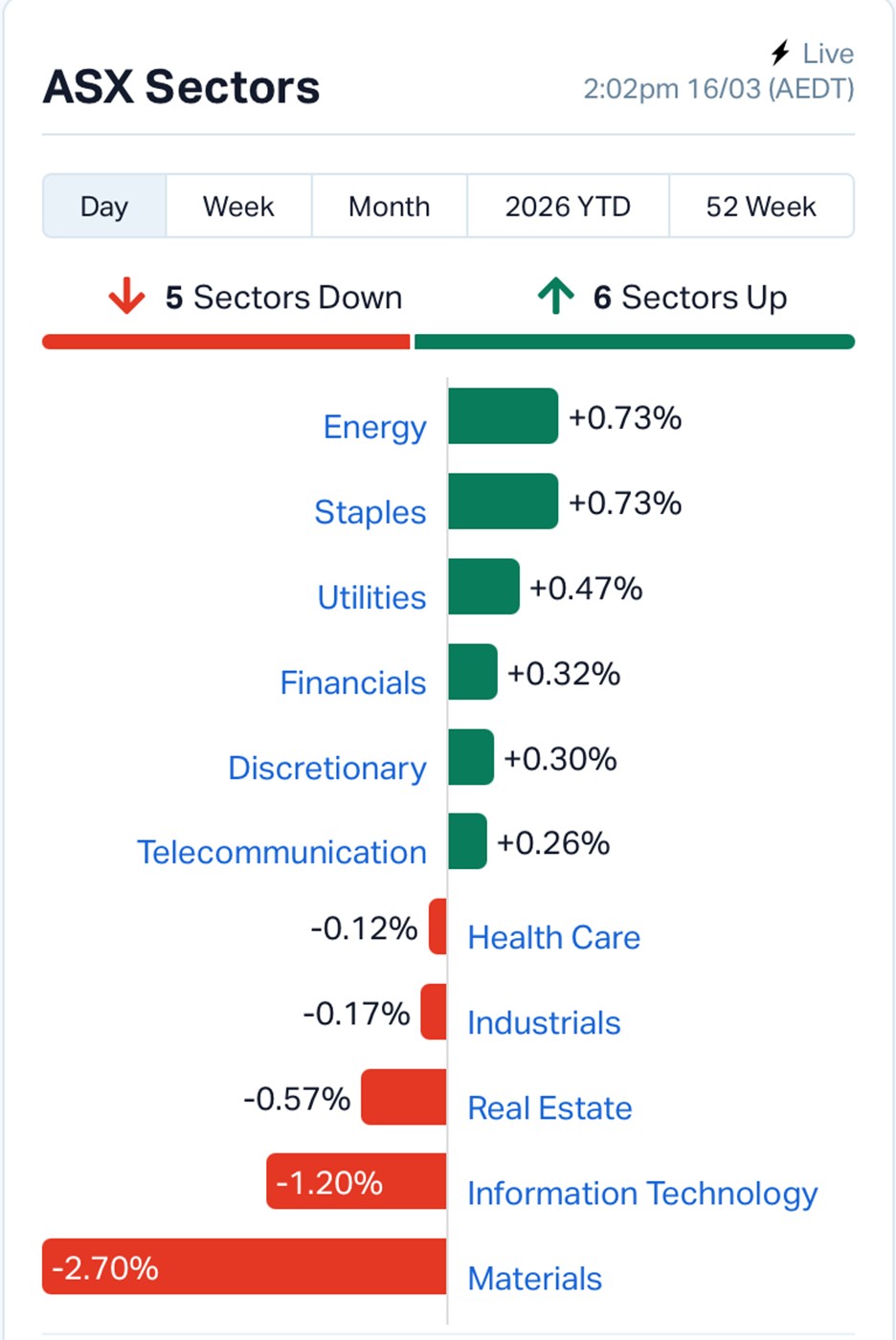
Energy stocks are climbing on surging oil prices, while technology and materials companies are sliding as investors brace for tighter monetary policy and slower economic growth.
Source:MarketIndex
The geopolitical spark
The immediate catalyst behind the cautious mood is the escalating conflict in the Middle East.
Over the weekend, tensions intensified following reports of military strikes targeting Iranian infrastructure linked to energy exports. The developments have placed the Strait of Hormuz, one of the world’s most critical oil shipping routes, firmly in the spotlight.
Roughly 20 percent of global oil supplies pass through the narrow waterway, according to the US Energy Information Administration. Any disruption to shipping there can ripple quickly through global energy markets.
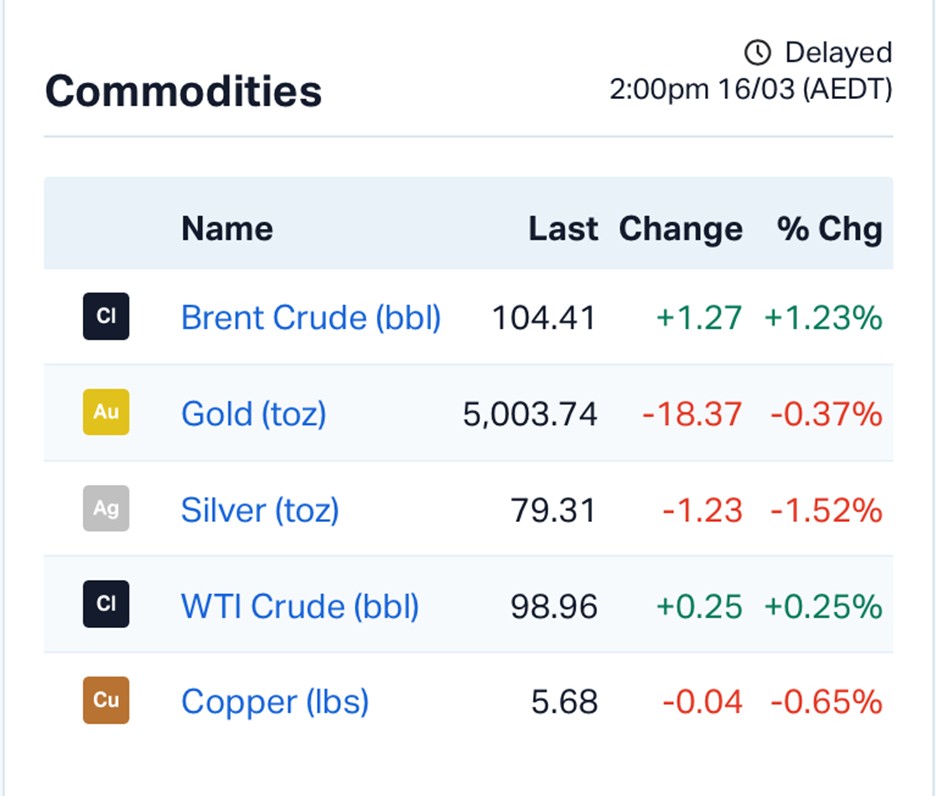
That fear has pushed Brent crude to about US$104.10 per barrel, while US benchmark WTI crude trades near US$98.66.
Source: MarketIndex
Despite the sharp geopolitical backdrop, the oil rally has been relatively contained so far.
Some analysts believe major buyers such as China and India may still have access to supply routes, preventing a more dramatic price spike.
However, the macroeconomic implications remain significant.
Economists at Barclays have warned that if oil prices remain above US$100 per barrel, global economic growth could decline by around 0.2 percentage points, while inflation pressures intensify.
RBA decision looms
Closer to home, investors are also focused on the upcoming Reserve Bank of Australia policy meeting, which could deliver another interest rate increase.
Markets are increasingly pricing in a 25 basis point hike as policymakers continue their battle against persistent inflation.
Some economists argue that a slowdown in economic activity may now be unavoidable.
HSBC chief economist Paul Bloxham recently described the situation bluntly, stating that Australia’s economy may need a period of weaker growth to bring inflation under control.
In practical terms, higher interest rates could affect everything from mortgage repayments to business investment.
For equity markets, tighter monetary policy typically reduces risk appetite and pressures growth sectors such as technology.
A market divided
The sector breakdown on Monday highlights the divergence in investor sentiment.
Energy stocks are among the few areas trading firmly in the green.
Companies tied to oil and gas production are benefiting from the surge in crude prices.
Energy producer Karoon Energy rose about 4.9 percent, while major producers such as Woodside Energy and Santos also recorded gains.
At the same time, sectors more sensitive to economic conditions are struggling.
The ASX All Technology Index has dropped 1.15 percent, reflecting the global trend of investors rotating away from high growth technology companies during periods of rising interest rates.
Materials stocks have also come under pressure, with the ASX resources index down around 1.69 percent.
The gold sector has been particularly weak.
The ASX All Ordinaries Gold Index has fallen 3.5 percent, even though gold prices themselves remain elevated near US$5,015 per ounce.
This divergence suggests that operational factors and profit taking may be weighing on mining stocks despite the strong commodity backdrop.
Winners and losers
Individual stock movements illustrate how sharply sentiment has shifted across sectors.
Among the day’s strongest performers is Peet Ltd, which gained nearly 5.7 percent, while plumbing products manufacturer Reliance Worldwide rose close to 5 percent.
Energy stocks also feature prominently among the market’s top gainers.
On the losing side, technology and mining names dominate the fallers list.
Titanium producer IperionX slumped more than 16 percent, while several exploration and mining companies also posted double digit declines.
Stay ahead of the market
The most important stories, delivered to your inbox. No noise, just what matters.
By subscribing, you agree to our Privacy Policy.
Such moves highlight how quickly capital is rotating toward sectors perceived as more resilient during periods of economic uncertainty.
The global backdrop
International markets are facing similar pressures.
Wall Street ended last week lower, with the Nasdaq falling 0.93 percent and the S&P 500 dropping 0.61 percent as investors weighed rising oil prices against inflation concerns.
Asian markets have also been cautious.
Japan’s Nikkei 225 declined more than 1 percent, while Hong Kong’s Hang Seng index slipped nearly 1 percent.
Meanwhile, the Australian dollar has strengthened slightly to around 70.12 US cents, reflecting a mix of commodity strength and expectations for higher domestic interest rates.
A fragile moment for markets
For investors, the current environment represents a collision of powerful economic forces.
Geopolitical tensions are pushing energy prices higher, while central banks remain focused on controlling inflation.
Together, those dynamics create what economists often describe as a stagflation risk, where prices rise even as economic growth slows.
The Australian market, with its heavy exposure to resources and energy companies, may prove more resilient than some global peers.
But volatility is likely to remain a defining feature in the weeks ahead.
With the Reserve Bank decision looming and geopolitical tensions still simmering, traders appear reluctant to make large bets.
For now, the ASX is holding its ground.
Whether that resilience lasts may depend on the next move from both the central bank and the global energy market.
Source: ASX market data, global commodities pricing, Barclays economic outlook and energy market analysis.
What is your take on this story?
Disclaimer - Skrill Network is designed solely for educational and informational use. The content on this website should not be considered as investment advice or a directive. Before making any investment choices, it is crucial to carry out your own research, taking into account your individual investment objectives and personal situation. If you're considering investment decisions influenced by the information on this website, you should either seek independent financial counsel from a qualified expert or independently verify and research the information.