


ASX Update: Block Surges 27% on AI Restructuring While Coles Drops as Profit Hit Exposes Retail Pressures


Key Highlights:
- ASX 200 flat at 9,169 as reporting season drives sharp stock moves
- Block jumps 27% after announcing 4,000 job cuts tied to AI efficiency push
- Coles falls nearly 9% after profit drops 11.3% amid wage underpayment costs
- Tech and resources outperform while consumer staples and banks lag
- Market signals shift toward rewarding efficiency and punishing compliance failures
Australia’s share market is sending a blunt message this reporting season. Companies promising efficiency through artificial intelligence are being rewarded, while those grappling with regulatory costs and weaker earnings are facing swift punishment.
By midday on Friday, the benchmark S&P/ASX 200 was hovering at 9,169 points, down slightly by 0.06 percent, reflecting a fragile balance between optimism in technology and caution in consumer sectors. The broader All Ordinaries index was also flat at 9,406 points, according to ASX market data.
Beneath the calm surface, however, the day’s biggest corporate moves reveal a deeper shift underway.
AI cuts spark explosive rally in Block
The standout performer was Block Inc., which surged more than 27 percent to A$93.60, making it the top gainer on the ASX.
The rally followed the company’s announcement that it plans to cut nearly half its workforce, about 4,000 jobs, as part of a sweeping push toward automation and artificial intelligence.
The decision reflects a broader shift happening across global technology firms. Instead of using AI primarily to create new products, companies are now using it to replace routine tasks and reduce costs.
This strategy signals what analysts often call the “implementation phase” of the AI boom. Early enthusiasm was driven by promise and experimentation. Now, companies are expected to show measurable savings and improved margins.
The technology sector reflected this optimism, with the ASX All Technology index rising 1.59 percent to 2,842.8 points, outperforming the broader market.
Companies tied to digital infrastructure and automation also benefited. Pexa Group Ltd rose more than 7 percent after reporting a return to profitability, while Lynas Rare Earths Ltd gained 7.45 percent amid renewed interest in critical minerals used in advanced electronics.
Source: MarketIndex
Coles profit slump exposes cost of compliance
While technology surged, Australia’s consumer sector delivered a sobering contrast.
Shares in Coles Group Ltd fell 8.86 percent to A$20.23, after the supermarket giant reported an 11.3 percent drop in half year profit to A$511 million.
The decline was driven largely by a A$235 million hit linked to wage underpayment remediation, underscoring the financial impact of regulatory compliance failures.
The result highlights the complex position facing supermarkets. While grocery sales remain relatively stable because food is an essential purchase, profit margins can be eroded by rising costs, legal settlements, and compliance obligations.
Despite the profit drop, analysts noted that Coles’ supermarket margins remained relatively strong at around 5.8 percent, suggesting its core operations remain competitive even as regulatory costs weigh on earnings.
Still, the share price reaction reflects a clear shift in market priorities.
Investors appear increasingly unwilling to overlook legal and governance issues, even when underlying business performance remains solid.
Reporting season divides winners and losers
The reporting season has created stark contrasts across sectors.
Retailer Harvey Norman Holdings Ltd fell more than 7 percent despite reporting a 16.5 percent increase in pre tax profit. Investors appeared cautious about its reliance on international markets and uncertain domestic demand.
Meanwhile, auto parts company Bapcor Ltd plunged nearly 50 percent, the steepest decline of the day, following disappointing guidance and results.
These sharp moves highlight how reporting season can rapidly reshape valuations as new financial data replaces expectations.
Global tech sentiment adds caution
The mixed performance in Australia mirrors uncertainty overseas.
In the United States, the Nasdaq fell 1.18 percent overnight, while the S&P 500 dropped 0.54 percent, reflecting cooling momentum in technology stocks.
Even AI leaders such as NVIDIA Corporation faced pressure after earnings failed to exceed elevated expectations.
This suggests markets are becoming more selective, rewarding companies that deliver tangible financial gains from AI while questioning those still in early investment phases.
Sector trends reveal shifting priorities
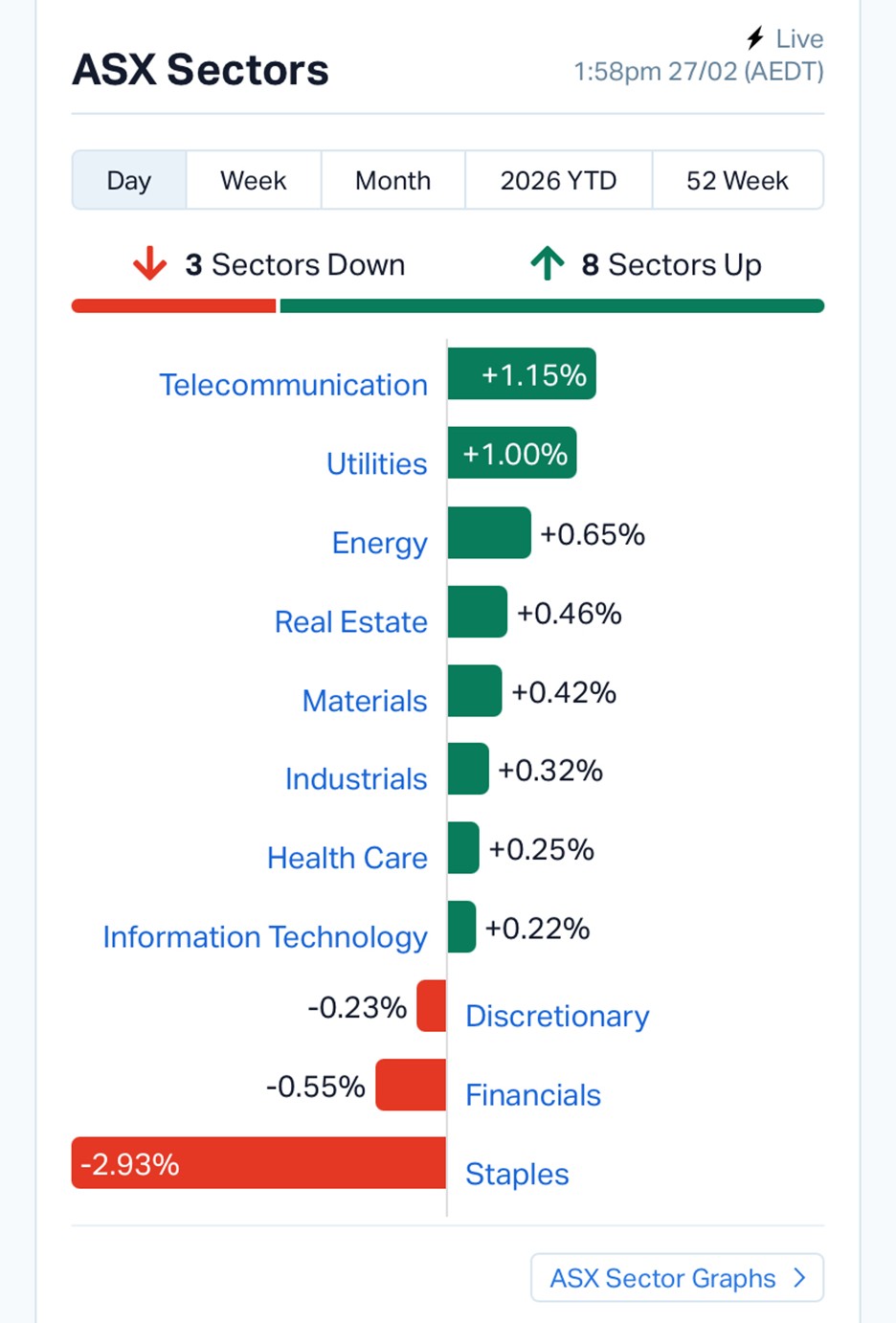
The broader ASX sector performance shows a clear divide.
Resource stocks performed strongly, with the ASX 200 Resources index rising 0.71 percent, supported by stable commodity prices and continued global demand.
Gold stocks also rallied, with the ASX Gold index climbing 3.25 percent, reflecting ongoing interest in defensive assets amid economic uncertainty.
In contrast, financial stocks weakened, with the ASX Banks index falling 1.17 percent, while consumer staples declined 3.31 percent, led by Coles.
Stay ahead of the market
The most important stories, delivered to your inbox. No noise, just what matters.
By subscribing, you agree to our Privacy Policy.
The volatility index remained low at around 11.7, indicating overall market confidence remains stable despite sector level turbulence.
The deeper shift shaping markets
The contrasting fortunes of Block and Coles capture a broader transition underway in financial markets.
Companies demonstrating cost discipline, automation and operational efficiency are attracting capital. Those facing regulatory penalties or weaker profit growth are being repriced quickly.
This pattern reflects a shift in market psychology. After years of growth driven by easy money and expansion, the focus has turned to profitability, efficiency and execution.
For the broader economy, the implications extend beyond stock prices.
The rise of automation promises productivity gains, but it also raises questions about employment and workforce transitions.
At the same time, increased regulatory scrutiny highlights rising expectations for corporate governance and compliance.
The bottom line
The ASX may appear calm on the surface, but the reporting season is reshaping the market beneath it.
Technology companies embracing AI driven efficiency are surging. Traditional consumer giants facing regulatory costs are struggling.
As artificial intelligence moves from concept to implementation, the market is making its priorities clear.
Efficiency is rewarded. Compliance failures are punished. And in this new phase, execution matters more than ever.
Source: ASX market data, company earnings releases, reporting season updates
What is your take on this story?
Disclaimer - Skrill Network is designed solely for educational and informational use. The content on this website should not be considered as investment advice or a directive. Before making any investment choices, it is crucial to carry out your own research, taking into account your individual investment objectives and personal situation. If you're considering investment decisions influenced by the information on this website, you should either seek independent financial counsel from a qualified expert or independently verify and research the information.