


Is Imugene (ASX: IMU) the Next Big Takeover Target? 100% Cancer Trial Results Spark Biotech Buzz


Key Highlights
- Imugene Limited reports 100% response rate in leukemia patients in Phase 1b study
- 80% response rate seen in marginal zone lymphoma cohort
- Trial involves heavily pre-treated cancer patients with limited treatment options
- Off-the-shelf CAR T therapy azer-cel could reshape cancer treatment logistics
- Strong clinical interest accelerating trial enrolment
While global markets remain focused on oil shocks and economic volatility, a small Australian biotech company has delivered news that is turning heads in the medical world.
Imugene Limited reported striking results from its Phase 1b clinical trial of azer-cel, an experimental cancer therapy designed to treat advanced blood cancers.
In early data released Tuesday, the therapy achieved a 100 percent overall response rate among patients suffering from chronic lymphocytic leukemia and small lymphocytic lymphoma (CLL/SLL). All four patients treated in that subgroup showed measurable tumour responses.
For a clinical trial, that number is rare.
In oncology research, even partial success rates are often celebrated. A perfect response rate, even in a small cohort, tends to capture attention across the biotech industry.
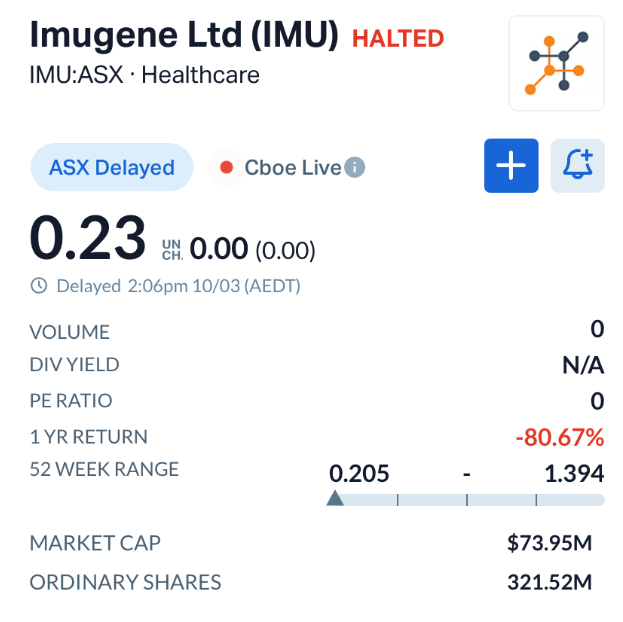
At the time of writing this article, IMU shares were halted as of 2:06 PM
Encouraging results in multiple cancers
The promising signals did not stop there.
Imugene also reported an 80 percent response rate in marginal zone lymphoma, another form of blood cancer. In that group, three out of five patients achieved a complete response, meaning no measurable cancer could be detected after treatment.
Importantly, the patients enrolled in the study were heavily pre-treated, having already undergone multiple prior therapies before joining the trial.
For patients who have exhausted existing treatment options, even modest response rates can be meaningful. The early data suggests the therapy may offer new hope for people with difficult-to-treat blood cancers.
A new approach to CAR T therapy
The treatment being tested, called azer-cel, belongs to a rapidly growing class of immunotherapy known as CAR T cell therapy.
These treatments work by modifying immune cells so they can identify and attack cancer cells.
However, traditional CAR T treatments typically rely on extracting a patient’s own cells, modifying them in a lab and then reinfusing them weeks later.
Imugene’s therapy takes a different approach.
Azer-cel is allogeneic, meaning it can be manufactured in advance and delivered “off the shelf” without waiting for patient-specific cell processing.
In practical terms, that could make treatment faster and more scalable if the therapy eventually reaches commercial use.
Strong clinical interest
The early results appear to be generating significant attention among doctors.
According to the company, enrolment in the CAR T-naïve patient cohort is progressing faster than in earlier trial groups, reflecting strong clinical demand for new therapies in this area.
The trial is currently running across ten sites in the United States and five sites in Australia, with additional patient data expected as the study progresses.
The basket trial design also allows researchers to evaluate the therapy across multiple cancer types simultaneously, helping the company identify which indications may offer the fastest path to regulatory approval.
A multi-billion-dollar market
The commercial potential of therapies targeting these diseases is significant.
Many of the patients in the study had previously received Bruton tyrosine kinase inhibitors (BTK inhibitors), a class of drugs widely used to treat blood cancers.
These therapies alone generated around $12.1 billion in global sales in 2025, according to industry data cited in the company’s announcement.
Stay ahead of the market
The most important stories, delivered to your inbox. No noise, just what matters.
By subscribing, you agree to our Privacy Policy.
That scale highlights why large pharmaceutical companies closely watch promising clinical data emerging from smaller biotech firms.
Historically, breakthrough therapies in oncology have frequently triggered acquisition interest from major global drugmakers seeking to expand their pipelines.
Imugene Chief Executive Officer Leslie Chong said the results highlight the therapy’s potential across multiple cancer types.
“We are encouraged to see activity emerging across multiple lymphoma subtypes within the CAR T-naïve cohort, which highlights the potential breadth of azer-cel in areas of significant unmet medical need,” Chong said.
She added that expanding the trial to test the therapy alongside BTK inhibitors could further strengthen its clinical potential for patients who have failed earlier treatments.
Still early, but promising
Despite the excitement, it is important to remember that the therapy remains in early-stage clinical development.
Phase 1 trials are primarily designed to assess safety and early efficacy signals rather than deliver definitive proof of effectiveness.
Larger trials will be needed before regulators consider approval.
Still, the early signals have sparked renewed interest in Imugene’s pipeline and raised speculation about whether larger pharmaceutical companies could eventually take notice.
In an industry where breakthrough cancer therapies can reshape entire markets, even small clinical victories can signal much bigger possibilities ahead.
What is your take on this story?
Disclaimer - Skrill Network is designed solely for educational and informational use. The content on this website should not be considered as investment advice or a directive. Before making any investment choices, it is crucial to carry out your own research, taking into account your individual investment objectives and personal situation. If you're considering investment decisions influenced by the information on this website, you should either seek independent financial counsel from a qualified expert or independently verify and research the information.