


New Hope (ASX: NHC) Shares Slide as Profit Plunges 84% Despite Higher Coal Output


Key Highlights
- New Hope Corporation Ltd reports 84% drop in net profit to $54.3 million
- Interim dividend cut from 19 cents to 10 cents per share
- Coal prices fall more than 20% to US$137.80 per tonne
- Shares drop to around $4.97, down 6.3% in midday trade
- Company retains $616 million cash and $185 million operating cash flow
It was meant to be another steady earnings update from one of Australia’s most reliable dividend payers.
Instead, it turned into a reality check for the coal sector.
New Hope Corporation Ltd saw its shares slide sharply on Tuesday after reporting a steep 84 percent fall in net profit after tax, as cooling coal prices erased much of the windfall gains seen in recent years.
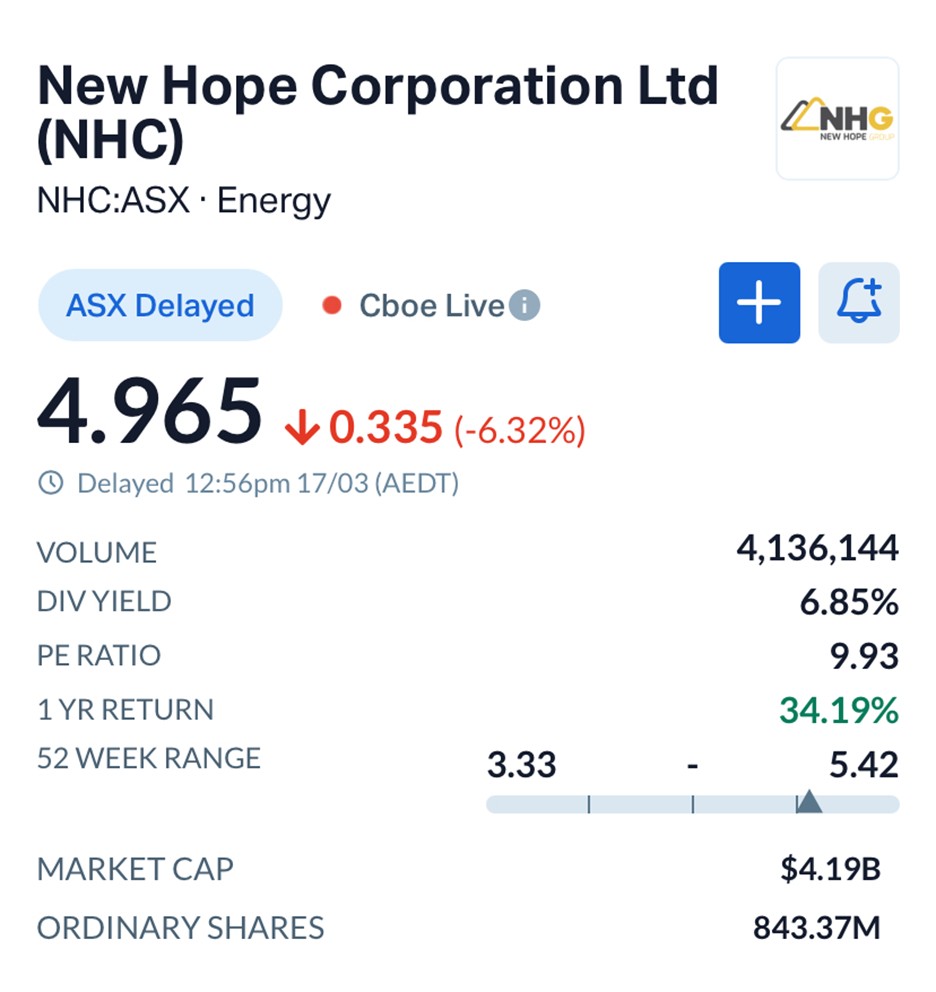
Source: MarketIndex
By early afternoon, the stock was trading near $4.97, down more than 6 percent, as investors digested the company’s latest half-year results.
The profit crunch
At the headline level, the numbers tell a stark story.
New Hope reported net profit of $54.3 million, a significant drop from the elevated earnings delivered during the peak of the global energy crisis.
The primary driver was not production, which actually improved, but pricing.
The company’s average realised coal price fell by more than 20 percent to US$137.80 per tonne, reflecting a broader cooling in global coal markets after the extreme highs of 2022 and 2023.
That decline highlights a key feature of commodity businesses. When prices fall, even strong operational performance can struggle to offset the impact.
Production holds steady, but margins shrink
Operationally, the company delivered a modest increase in output.
Saleable coal production rose to 5.5 million tonnes, suggesting that its assets continue to perform consistently.
Lower prices have compressed margins, meaning each tonne of coal sold generates less profit than before.
This shift is particularly important for investors who had grown accustomed to record earnings during the recent commodity boom.
Dividend disappointment
For many shareholders, the biggest blow came from the dividend.
New Hope reduced its interim payout from 19 cents per share last year to 10 cents, reflecting the sharp drop in profitability.
While the company still offers a dividend yield of around 6.85 percent, the reduction signals a transition from the extraordinary payouts of recent years to a more normalized earnings environment.
Dividend cuts often carry an outsized psychological impact, particularly for income-focused investors who rely on consistent cash returns.
A resilience narrative
Despite the profit decline, management has sought to emphasise the company’s financial strength.
Chief executive Rob Bishop pointed to the company’s ability to generate $185 million in operating cash flow during the period, even in a lower price environment.
The balance sheet also remains solid, with $616 million in cash reserves, providing flexibility for future investment or downturns.
This “resilience” narrative is becoming increasingly common among resource companies navigating volatile commodity cycles.
It reflects a shift from growth at any cost toward maintaining strong cash positions and operational discipline.
A broader industry signal
New Hope’s results are not just about one company.
They offer a window into the broader coal market, which has moved from a period of extreme scarcity and high prices to a more balanced, and less lucrative, phase.
According to data from global commodity trackers, thermal coal prices surged to record highs during the energy crisis triggered by geopolitical tensions and supply disruptions.
As those pressures eased, prices have gradually retreated, although they remain above long-term averages.
Stay ahead of the market
The most important stories, delivered to your inbox. No noise, just what matters.
By subscribing, you agree to our Privacy Policy.
This transition is now flowing through to company earnings across the sector.
Investor takeaway: cash cow or caution sign?
For investors, the key question is whether New Hope remains an attractive income play or a warning sign for the sector.
On one hand, the company still generates strong cash flow and maintains a healthy balance sheet.
On the other, the sharp drop in profit and dividends highlights how quickly commodity cycles can turn.
The market reaction suggests that investors are recalibrating expectations.
The era of extraordinary coal profits may be fading, replaced by a more normalized environment where earnings are closely tied to fluctuating global demand and pricing.
The bottom line
New Hope’s latest results underline a simple but powerful truth about resource markets.
Booms can be dramatic, but so can the return to normal.
While the company remains financially robust, the sharp decline in profit and dividends has reminded investors that commodity cycles are rarely smooth.
And in today’s market, even a steady producer can feel the pressure when prices begin to cool.
Source: New Hope ASX half-year results announcement, global coal pricing data.
What is your take on this story?
Disclaimer - Skrill Network is designed solely for educational and informational use. The content on this website should not be considered as investment advice or a directive. Before making any investment choices, it is crucial to carry out your own research, taking into account your individual investment objectives and personal situation. If you're considering investment decisions influenced by the information on this website, you should either seek independent financial counsel from a qualified expert or independently verify and research the information.